
AirBolt GPS uses advanced positioning technology designed to provide reliable location information across a wide range of environments.
When your device attempts to determine its location, AirBolt will first use its primary positioning system to obtain the most accurate location available.
If a suitable location cannot be obtained, AirBolt can then use Backup Location Estimation as an additional fallback.
This layered approach helps improve your chances of receiving useful location information, whether your AirBolt is outdoors, indoors, travelling through an airport, inside a vehicle or moving through a built-up area.
Getting the Best Location Accuracy
For the best possible location accuracy, position your AirBolt GPS with the logo facing upwards where practical.
For optimum performance:
Position the device with the logo facing upwards.
Avoid placing the device beneath large amounts of metal or other materials that may significantly interfere with positioning signals.
Where practical, provide the device with a clearer view of its surroundings.
Remember that the device's immediate environment can affect location accuracy.
An outdoor area with a clear view of the sky will generally provide excellent positioning conditions.
However, AirBolt does not need to be outdoors to provide useful or accurate location information.
AirBolt's advanced positioning system has been designed to continue working effectively across many indoor and built-up environments as well.
This makes AirBolt suitable for tracking in environments such as:
Homes
Offices
Hotels
Airports
Warehouses
Shopping centres
Vehicles
Apartment buildings
Urban areas
Other indoor or built-up environments
As with any location technology, performance can vary depending on the environment surrounding the device.

Understanding Backup Location Estimation:
Backup Location Estimation is an additional fallback layer within AirBolt's location system.
It is used when AirBolt's primary positioning system is unable to obtain a suitable location.
Rather than simply leaving you without an updated position, Backup Location Estimation may be able to provide an approximate location for your device.
In simple terms:
Primary AirBolt Positioning → Backup Location Estimation
Under normal conditions, AirBolt will attempt to obtain the best available location through its primary positioning system first.
Backup Location Estimation only comes into play when that primary method cannot provide a suitable location.

Why Do We Use Backup Location Estimation?
No single positioning technology can guarantee an accurate location in every possible environment.
A device may occasionally be:
Deep inside luggage or a package
Heavily surrounded by metal
Inside a particularly challenging building or structure
Moving through environments where positioning conditions change rapidly
Located somewhere with limited positioning information available
Backup Location Estimation gives AirBolt an additional opportunity to determine approximately where the device is.
Instead of having no location information at all, you may still receive an estimated area that helps narrow down where your AirBolt is located.
When Is Backup Location Estimation Useful?
Backup Location Estimation can be particularly useful when tracking assets that move through a wide variety of environments.
Luggage and Travel
Luggage can travel through airports, baggage areas, vehicles, aircraft infrastructure and other environments where positioning conditions can constantly change.
AirBolt will automatically attempt to obtain the best location available.
If its primary positioning system cannot establish a suitable location, Backup Location Estimation provides an additional layer that may still help determine the approximate location of your luggage.
For example, this can help indicate whether your luggage has reached your destination or remains in another general area.
Vehicles and Moving Assets
Vehicles regularly move between open roads, underground or covered parking, warehouses, buildings and dense urban environments.
Positioning conditions can therefore change throughout a journey.
AirBolt's primary positioning system will always attempt to provide the best available location first, with Backup Location Estimation available as an additional fallback if required.
Lost or Misplaced Items
When trying to locate a lost item, even an approximate position can be extremely valuable.
If AirBolt's primary positioning system cannot obtain a suitable location, Backup Location Estimation may help narrow the search to a particular area.
Knowing the general vicinity of an item can significantly improve your chances of finding it compared with having no location information at all.
Understanding the Colours on Your Map
The coloured dots on your AirBolt map help you understand the type and expected accuracy of the location being displayed.
Green = Primary Location
Highest accuracy
A green location indicates that AirBolt has obtained a location using its primary positioning system.
Blue = Backup Location Estimation
Medium accuracy
A blue location indicates that Backup Location Estimation has been used and has provided a reasonably useful estimated position.
Red = Backup Location Estimation
Lower accuracy
A red location indicates that Backup Location Estimation has been used, but the estimated position is less precise.
The colour gives you an indication of the expected accuracy of the location shown on the map.
Does Indoor Use Mean Lower Accuracy?
Not necessarily.
AirBolt has been designed to provide useful positioning across a wide range of real-world environments, including indoors.
Being indoors does not automatically mean your device will use Backup Location Estimation.
AirBolt will first attempt to obtain a suitable location through its primary positioning system.
Only if that system cannot determine a suitable position will Backup Location Estimation be used.
This means many indoor locations can still appear as a normal green location.
Location Accuracy Can Vary
The accuracy of any location system can vary depending on the surrounding environment.
Factors that may affect positioning include:
Heavy metal structures
Deep indoor environments
Underground areas
Dense construction materials
How the device is positioned
Whether the device is heavily enclosed
The amount of positioning information available around the device
For the best possible results, we recommend positioning your AirBolt with the logo facing upwards and avoiding unnecessary signal obstruction wherever practical.
AirBolt will automatically attempt to obtain the best available location each time the device reports.
How to turn on Backup Location Estimation:
Backup Location Estimation can be enabled through either the AirBolt app or the AirBolt Management Portal.
Via the AirBolt App
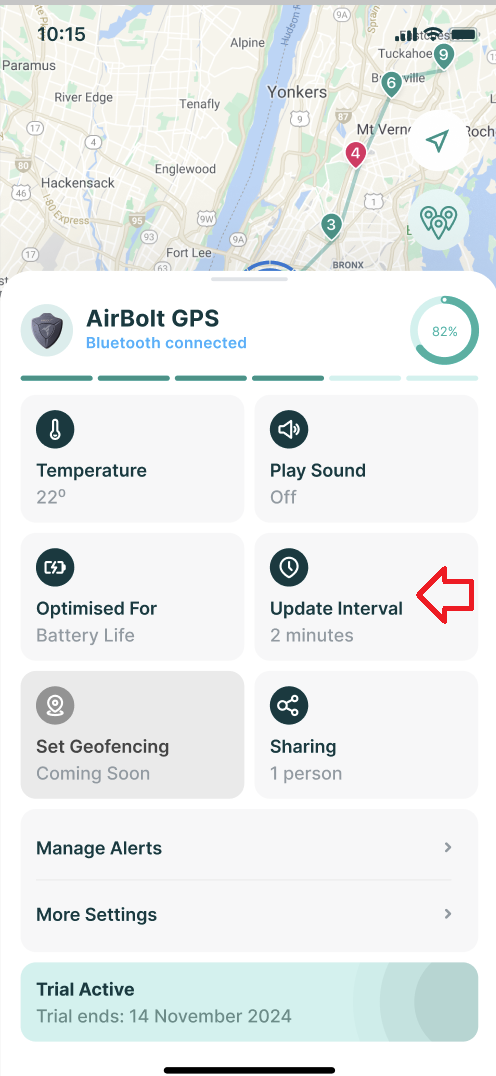
Open the AirBolt app and select your device.
Swipe up to reveal the device settings.
Select Update Interval.
4. Turn on Backup Location Estimation
5. Tap Save.
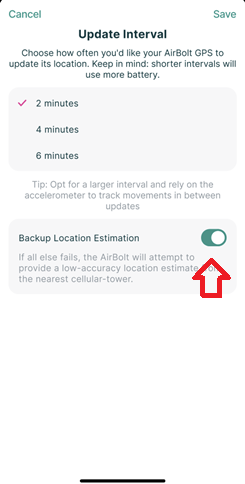
Once enabled, Backup Location Estimation will be available if AirBolt's primary positioning system cannot obtain a suitable location.
Via the portal:
Log in to your account at manage.theairbolt.com.
Select your AirBolt GPS.
Click the "..." button for your device.

4. Select Alerts & Reports.

5. Under the reporting options, enable Cellular Backup.

6. Click Save.
NOTE: This service is a back up and will only work when GPS location is not obtained. There are a limited number of cellular back up location pings you get per month. Please check your subscription plans for details.
FURTHER READING:
Important
Backup Location Estimation is designed as a fallback, not as the primary method of locating your AirBolt.
In most situations, your device will first attempt to obtain a suitable location using AirBolt's primary positioning system.
Backup Location Estimation is only used when a suitable primary location cannot be obtained.
Your subscription may include a limited number of Backup Location Estimation requests each month. Please refer to your current subscription plan for details.
Getting the Best Experience From Your AirBolt GPS
Location accuracy is only one part of getting the best performance from your AirBolt GPS.
Your reporting frequency, responsiveness settings and battery preferences also play an important role.
We strongly recommend reviewing the following guides.
Setting Up Your Reporting Schedule
How frequently your AirBolt reports its location can significantly affect both tracking frequency and battery life.
Shorter reporting intervals provide more frequent location updates, while longer intervals can significantly extend battery life.
Choosing the right reporting schedule will help you balance tracking performance with battery life for your particular use case.
Please see this article to learn more about this.
Responsive Mode vs Battery Optimised Mode
AirBolt also allows you to choose how the device balances responsiveness and battery life.
Responsive Mode keeps the device more readily available for communication.
Battery Optimised Mode allows the device to sleep more aggressively between reports, reducing power consumption and extending battery life.
Understanding this setting is important because it can significantly affect how quickly your AirBolt responds and how long its battery lasts.
Please see this article to learn more about this.
In Summary
AirBolt is designed to automatically use the best available positioning method for the environment it is in.
For the best possible results:
Position your AirBolt logo-side upwards where practical.
Avoid heavily obstructing the device with metal or other signal-blocking materials.
Enable Backup Location Estimation as an additional fallback.
Choose a reporting schedule suited to your tracking needs.
Select the appropriate balance between responsiveness and battery life.
In most situations, AirBolt's primary positioning system will provide the location you need.
When it cannot, Backup Location Estimation provides an additional layer to help ensure you still have useful information about where your device may be.
Note once again, this is highly encouraged as if these is not understood, your experience with the GPS may be suboptimal.